Burnout, performance and culture
The people struggling hardest rarely say so. Burnout, bullying and withdrawal show up in performance, in silence and in the people who leave, long before they show up in an engagement survey. Reaching in finds them while they can still be fixed.


Why the survey misses it
Why the annual survey keeps missing it
Most people don't reach out when they're struggling. Not because help isn't available, but because in the moment it matters, they don't trust the pathway to support.
Organisations rely on annual surveys and reactive EAPs, missing the early window. Quarterly surveys miss weekly movement.
Without trusted pathways, early risk signals go unreported and unmanaged.
Good people, wrong design: the survey and the awareness day are not the problem. Support that waits to be asked is.
The signs
Three signs people don't feel safe speaking up
Burnout, bullying and withdrawal rarely announce themselves. They show up as what people stop saying.
The survey says fine. The exit interview says otherwise.
People give the safe answer to the annual survey and the honest one on the way out. When the two disagree, the problem is not the survey. Speaking up felt unsafe while it still mattered.
Problems arrive as complaints, resignations and claims, never as early conversations.
When the first time you hear about a workload or a manager is a formal process, people have already decided that raising it informally was not worth the risk.
The quiet team.
Fewer questions in meetings. Nobody flags the near miss. Bullying that everyone knows about and nobody reports. Silence reads as stability, until it reads as turnover.
What it actually takes
Psychological safety is built in a loop, and broken at any step
It is not a value on a poster. It is built, or lost, in a loop that has to repeat: people are invited to speak, they are heard without repercussion, and they see action taken on what they raised, or at least see it addressed. Break any step and people stop speaking. Support only works when people feel safe enough to use it.
- 1
A safe, repeated invitation to speak.
Not once a year. Regularly, outside the reporting line, with nothing a person says held against them.
- 2
Being heard, without repercussion.
By someone who knows how to listen, and whose job is to act on it, not to judge it.
- 3
Seeing that it was taken seriously.
Something changes, or at least someone addresses it and says why. That is the moment trust is built, or lost.
Trust is not just emotional. It is a critical mechanism for early risk detection and intervention. Asking every person, regularly, is the only real leading indicator.
What it looks like from the inside
Three stages of one person's year, and what a regular check-in would have surfaced at each.
Emotional Strain
John, a high-performing Lead, becomes a full-time carer for his father overnight; he stays silent, but his internal capacity is instantly halved.
Emotional strain is now a leading indicator of risk, yet his KPIs remain "Green", creating a total blind spot for leadership.
That his capacity had halved, in his own words, de-identified.
The Withdrawal
Unable to sustain the dual burden, John quietly withdraws from team collaboration and stops contributing to the culture.
Quarterly surveys miss this weekly movement; the psychosocial hazard of role overload is now established but invisible.
A team theme of role overload, weeks before the survey.
Behavioural Change
A manager notices John is unkempt and exhausted but pushes for target achievement rather than exploring his capacity.
By ignoring visible strain, the business fails its primary duty of care to assess and control risks at the source.
A responder trained to explore capacity rather than push for targets.
Three solutions, one model
How reaching in builds the loop
Emotional Pulse is a set of tools for exactly this loop: a safe way to check in, people trained to hear what comes up, and a report that makes the response visible.
The repeated, safe invitation
Proactive check-ins
Every person gets a confidential check-in, every cycle, never with their own manager, with nothing they say affecting their work. The people who would never raise a hand get asked, and what comes back reaches someone whose job is to act on it.
Proactive check-insBeing heard
Mental Health Training
Leaders and responders who know how to listen without judging, support without taking over, and escalate when it matters. What is raised lands with a person who was trained for exactly that moment.
Mental Health TrainingThe everyday safe space
The Emotional Pulse App
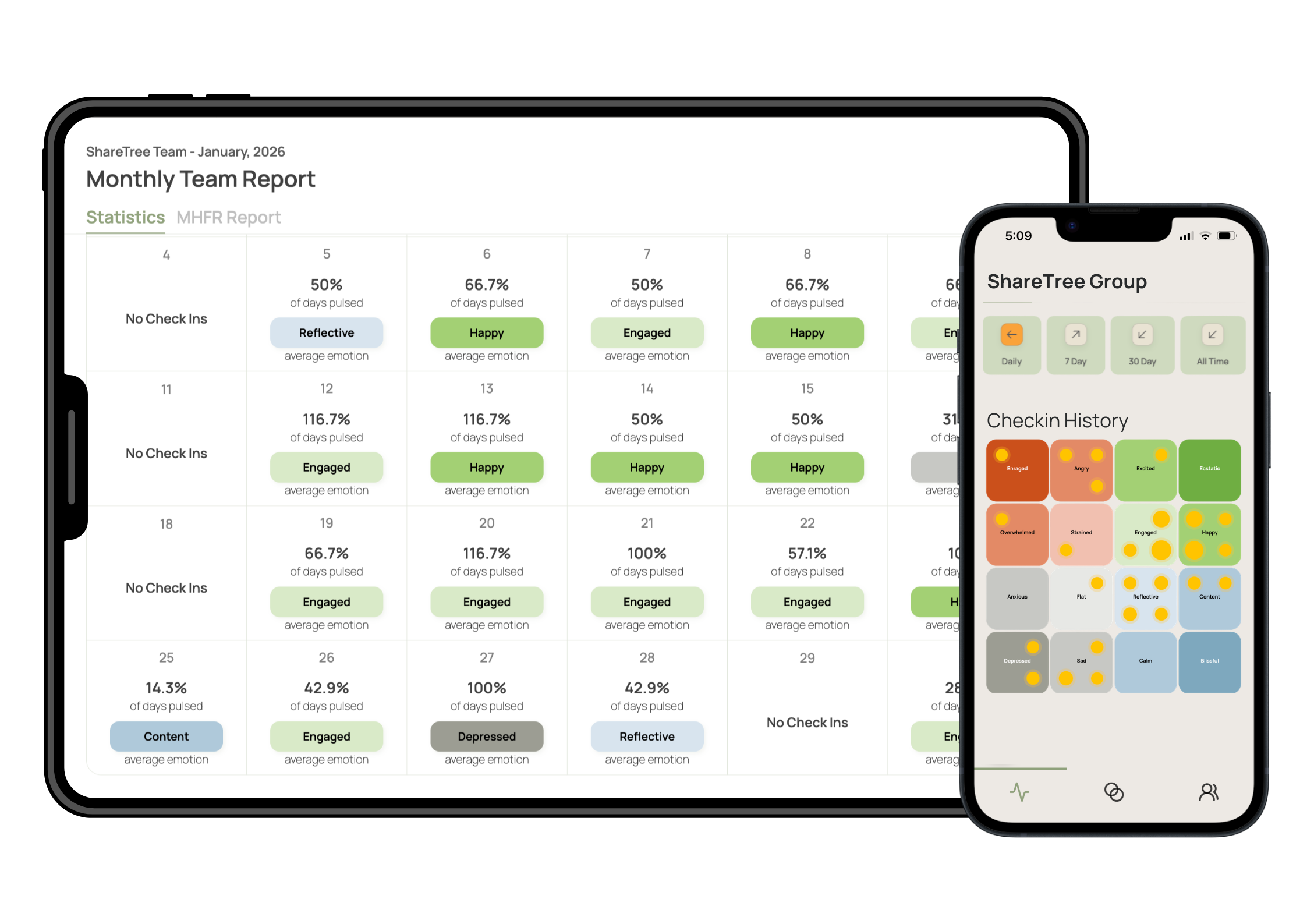
A 30-second check-in and a trusted pair between the calls, so the invitation is daily, not quarterly. De-identified team trends each cycle show whether what people raised is moving.
Emotional Pulse App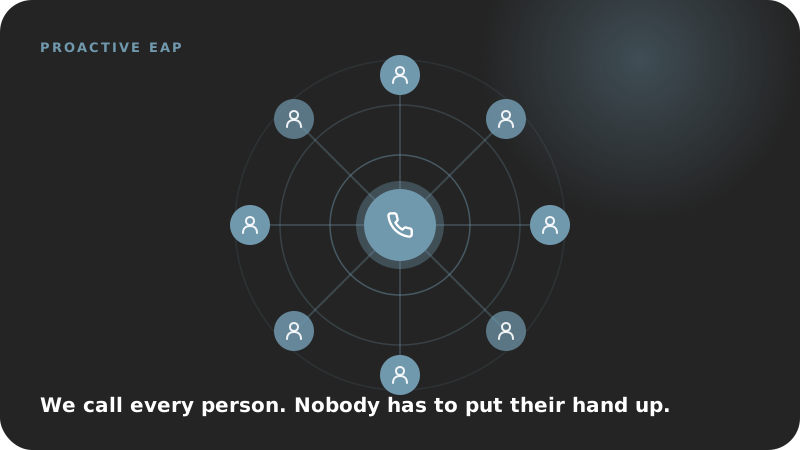

The repeated, safe invitation
Proactive check-insThe honest boundary: the tools create the safe space and surface the issues. Acting on them, and saying so, is still yours. That is what closes the loop.
Evidence
What our own research shows
85%
reported increased emotional awareness
77%
felt more supported in times of challenge
4.5×
less loneliness reported by people with trusted pairs
In our own study across more than 50,000 check-ins in 118 countries.
In our own self-reported research, 75% of trained responders rarely or never feel alone in distress, compared with 20% of untrained staff.
Questions about burnout, performance and culture

Worth 30 minutes?
A 30-minute conversation about your teams, what you are already seeing, and where reaching in would start. No obligation.
Other challenges we help with
Managing Psychosocial Risk
Meet the 2026 Code of Practice with controls that reach everyone, and the record that proves it.
Read moreReducing Mental Health Claims
A claim is the last signal, not the first. Find what precedes one while it can still be fixed.
Read moreBuilding Leadership Capability
From guessing who needs a conversation to knowing, and having it well.
Read more