Building leadership capability
Leaders want to help and don't know what to say. The hardest part isn't the conversation. It's knowing who needs one, and then having it well.

From guessing who needs a conversation to knowing
Most workplace mental health systems wait for someone to raise their hand. But the people struggling the hardest rarely do, until it's a crisis. That leaves leaders guessing, second-guessing, and catching people at the bottom of the fall instead of the top of it.

Waiting to be asked
The guess
- Support only activates when someone speaks up, and most won't.
- You rely on hallway cues, gut feel, and hoping you read the room right.
- By the time you're called in, it's already a crisis, not a check-in.
Seeing the signal
The signal
- A regular check-in that surfaces who's drifting, before they disappear.
- You spend your energy on the right conversations, at the right time.
- Early signal detection means you intervene upstream, not at the cliff edge.
The shift isn't about working harder. It's about moving from guessing who needs you to knowing who needs you, so every conversation you have actually lands.

The question worth asking
What would happen to your culture, your psychosocial risks and your mental health claims if every leader was equipped to identify, assess and support an employee or a peer in distress?
Not every leader a counsellor. Every leader able to notice, to have the conversation well, and to connect the person to the right help. Three things change.
Your culture
People raise things while they are still small, because the first person they tell knows what to do with it. Speaking up stops being a risk and becomes the normal thing to do.
Your psychosocial risks
Hazards get identified where they live: in a conversation with the person carrying them, weeks before they would show in a survey. Leaders become part of the control, not a gap in it.
Your mental health claims
Strain is met before it becomes injury. The pattern that ends in a claim, noticed late and handled badly, is interrupted at the first step by someone who was equipped to act.
Mental Health First Aid to understand. Mental Health First Responder training to act.
Mental Health First Aid gives leaders a shared language and the confidence to recognise when someone is struggling. Our clients tell us that when it came to the conversation itself, and to changing the conditions in a team, their leaders wanted practical tools and practice. That is what Mental Health First Responder training adds.
Read the signal
Recognise the difference between someone having a bad day and someone quietly unravelling, and know when each calls for a different response.
The Mirror Technique
Stop being the mechanic who tries to untie everyone's knots. Learn to be the mirror that reflects a person's own strengths back to them. It is more effective, and it is the only way the role is sustainable for a leader.
Hold the conversation
Stay present in emotionally charged moments, hold the space, and know what to say when the silence feels heavy.
What it asks of a leader
Three sessions of four hours live (online or in-house), or 3+ hours of online content self-paced, with a free introduction to start. Then the habit: a short check-in with your team between the calls, and the willingness to act on what the report shows. We recommend one trained responder for every 10 to 15 people. For leaders, the question is who on your team already gets turned to.
Three sessions of four hours, live
live online or in-house, or 3+ hours of online content self-paced, with a free introduction to start
One responder per 10 to 15 people
our recommendation; for leaders, the question is who on your team already gets turned to
Then the habit
a short check-in with your team between the calls, and the willingness to act on what the report shows
Three solutions, one model
How reaching in supports leaders
The call that reaches everyone
Proactive check-ins
The report tells you what to fix, de-identified, and never asks you to be the therapist.
Proactive check-insThe people who act
Mental Health Training
The skills to respond well, and the Mirror Technique that protects your own capacity.
Mental Health TrainingThe leading indicator
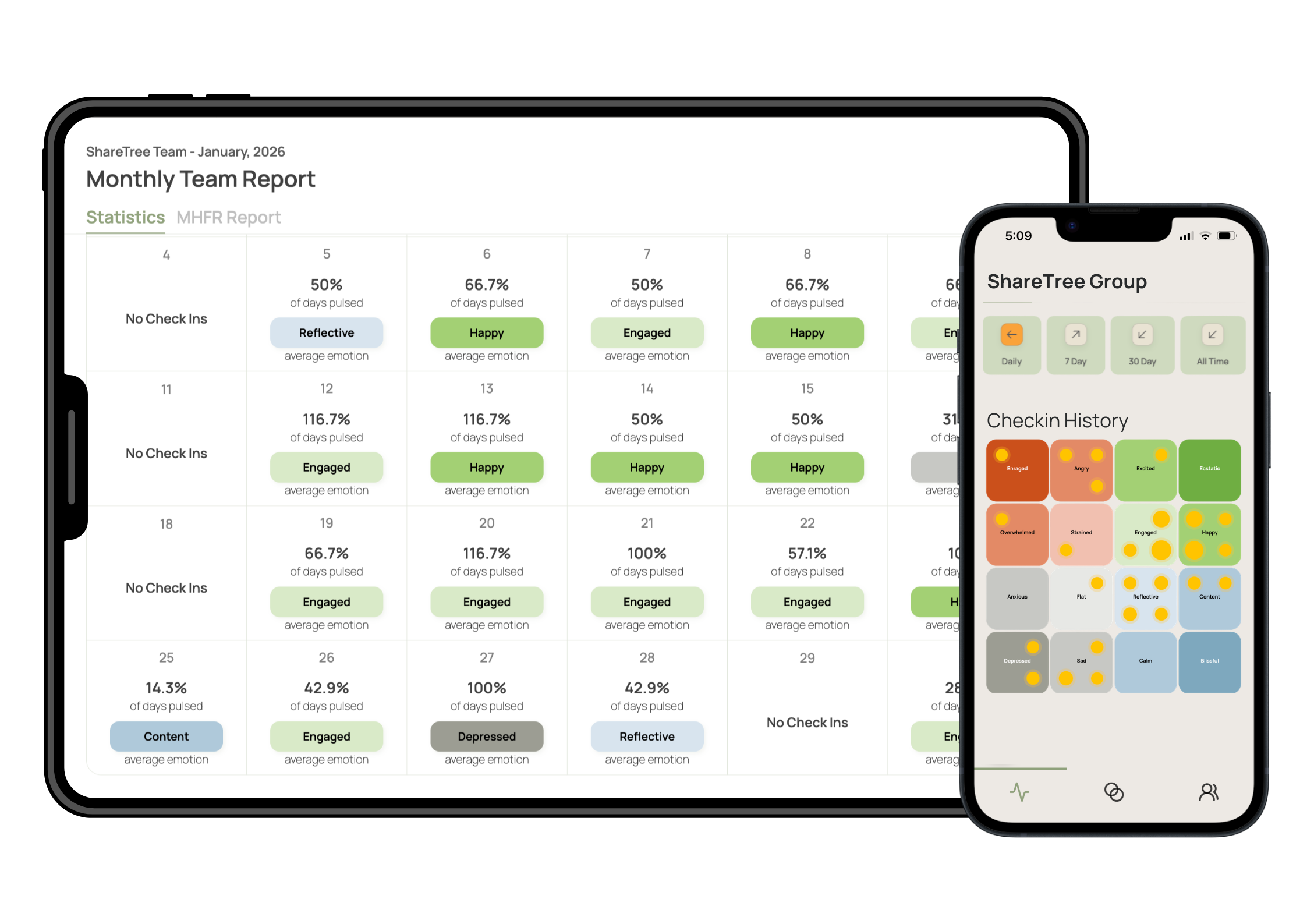
The Emotional Pulse App
Visibility without breaching trust: managers can see that check-ins are happening and the general picture across a team, never who said what.
Emotional Pulse App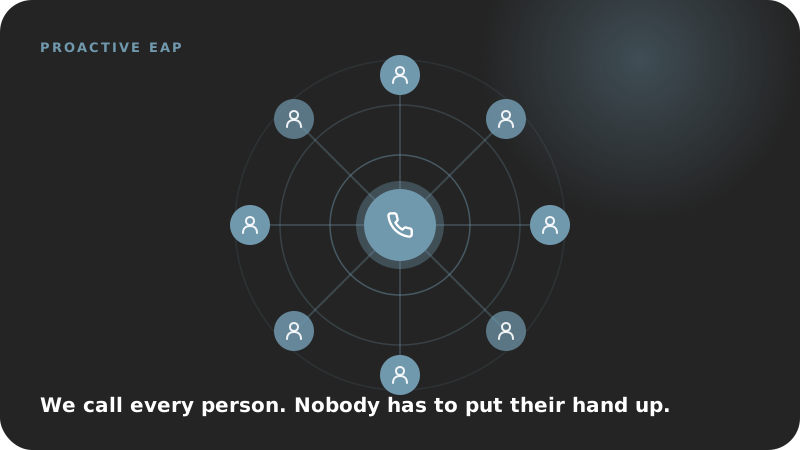

The call that reaches everyone
Proactive check-insEvidence and further reading
In our own self-reported research, 75% of trained responders rarely or never feel alone in distress, compared with 20% of untrained staff.
Questions about leadership capability

Stop guessing who needs a conversation.
Get the signal early and the skills to respond with confidence. Talk to us about training for your team, or start with the free introduction.
Other challenges we help with
Managing Psychosocial Risk
Meet the 2026 Code of Practice with controls that reach everyone, and the record that proves it.
Read moreReducing Mental Health Claims
A claim is the last signal, not the first. Find what precedes one while it can still be fixed.
Read moreBurnout, Performance & Culture
Burnout, bullying and withdrawal show in performance long before they show in a survey.
Read more