For People and Culture leaders: a programme your managers can run, and your people will use.
Around 5% of people ever use a traditional EAP. You carry retention, capability and wellbeing with tools that wait to be asked. Reaching in gives you a programme that reaches everyone, trains the people others already turn to, and starts within four weeks.
What you are accountable for
Retention, capability and a duty to consult
Around 1 in 4 people face a mental health challenge in a year. Around 5% ever use a traditional EAP. Gallup puts the cost of replacing an employee at one-half to two times their annual salary, and calls that a conservative estimate. The Code of Practice also asks you to consult the people affected when you identify and control psychosocial hazards. A regular check-in with every person is consultation that reaches everyone, with the record to show it.
What you can see today, and what you cannot
What the survey and the EAP report leave out
What you have
- An engagement survey once a year or once a quarter
- Exit interviews, after the decision
- An EAP utilisation number, after the fact
What you cannot see with them
- ✕Who is drifting before they disappear
- ✕Which teams are carrying sustained demand, where support is thin, where change has landed badly
- ✕Whether support is reaching the people who need it
Programme design
Designing the programme
Four decisions, made with us in the discovery call:
Cadence.
Monthly, every second month, quarterly or twice a year.
Delivery mode.
AI assisted, or 100% human by trained Mental Health First Responders. Either way the AI says it is an AI at the start of every call, and a call that needs a person gets one.
Support path.
A session with one of our responders or psychologists, or a connection to your own trained responders if you have them. Psychologist sessions are a separate line with a cap you agree in advance.
The app.
Optional, free for individuals, and the way the channel stays open between calls.
What is included
- A scheduled check-in call to every person you enrol
- A heads-up email before each call
- Up to three attempts to reach each person in the window, and callbacks at a time they ask for
- Continuous attention during the call to anything that suggests a person is at risk
- A path to support the person chooses in the call
- A de-identified report each cycle in your own portal
- A named list of people who could not be reached, so someone can follow up
- An account team that briefs your managers and gives them the words to introduce it
Not included, deliberately
- Therapy or clinical treatment (the call connects people to it)
- A crisis line (if someone is in danger the call directs them to emergency services)
- A monitoring tool (it will never tell you what an individual said)
- The training for your own people, which is priced on its own
- The app, which is free for individuals and optional for the organisation
Rollout within four weeks
From agreement to first report
Four steps, shown as a timeline; the weeks are the usual sequence, not a promise.
- 1
Scope and agreement.
Teams, cadence, mode, support path. Service agreement signed.
- 2
Set-up and manager briefing.
We enrol your people (name, mobile, team) and set up the groups; nothing for managers to install. Managers are briefed first, with talking points they can use as written.
- 3
Team introduction.
Managers introduce it at a team meeting or catch-up, then follow up with an email from the template. Staff receive the explainer video and the pre-call email with the start date, the frequency and the number the calls come from.
- 4
First calls, first report.
The calls begin. The first de-identified report arrives at the end of the cycle, and the follow-up list goes to your wellbeing administrator.
Managers are asked to lead with what it does for the person, a real way to raise things and be heard, and to be plain about privacy.
The assets you get
What your managers and your people receive
- Manager talking points
- The team email template
- The staff explainer video
- The pre-call email
- The staff page on this site, written for your people in their own terms
- The employee privacy notice
- The manager support page in the app
Three solutions, one model
What each solution does for you
The call that reaches everyone
Proactive check-ins
A check-in with every person, support arranged in the call, and a report each cycle that tells you what to work on.
Proactive check-insThe people who act
Mental Health Training
Train the people others already turn to. We recommend one trained responder for every 10 to 15 people; they can also carry the check-in calls.
Mental Health TrainingThe leading indicator
The Emotional Pulse App
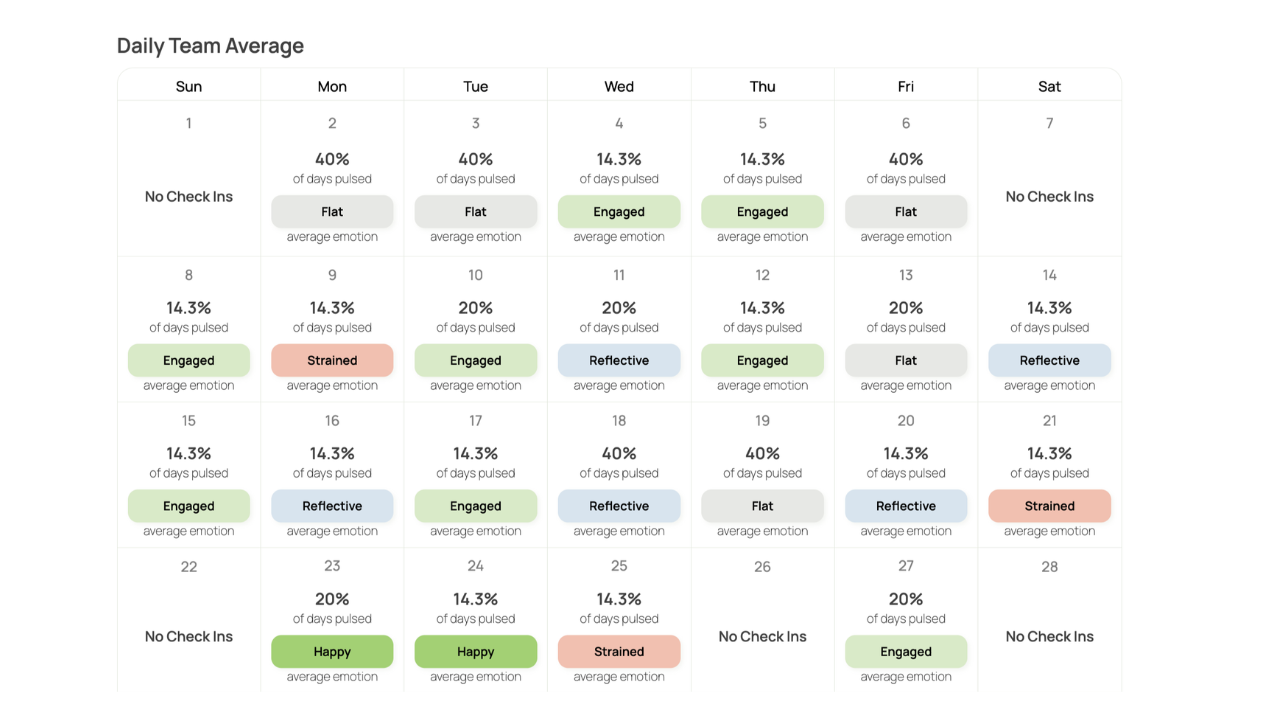
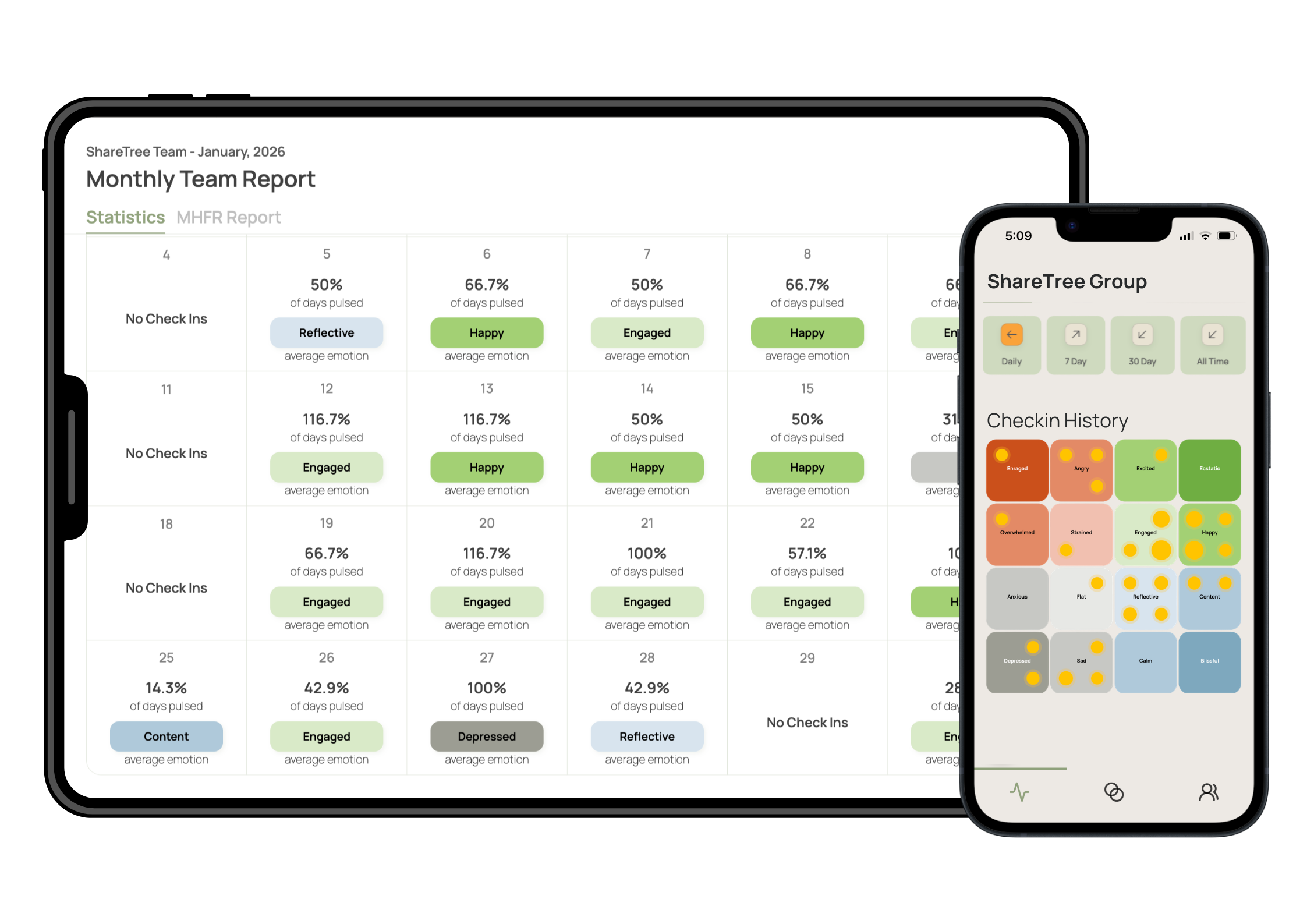
The daily habit between calls, with a trusted pair and two taps to support, free for every individual.
Emotional Pulse App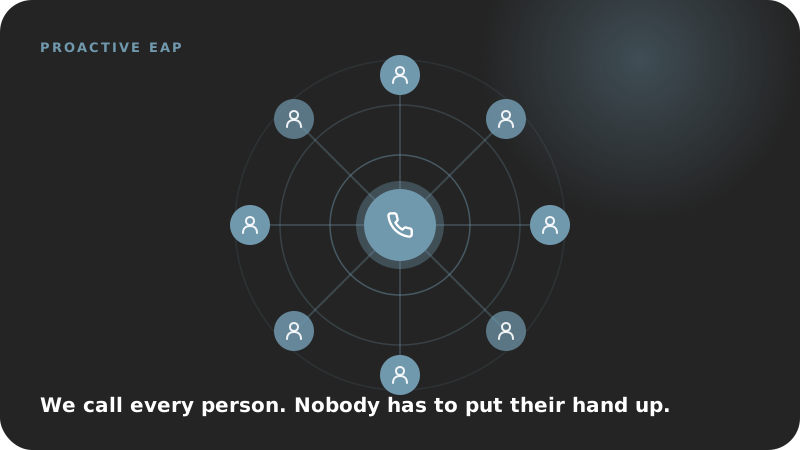

The call that reaches everyone
Proactive check-insWhat it asks of you
- 1
A sponsor.
Someone senior who says, in their own words, that this is real.
- 2
A wellbeing administrator.
The person who receives the follow-up list and makes sure someone checks in with the people the calls could not reach.
- 3
Managers willing to introduce it plainly.
Fifteen minutes at a team meeting and an email.
- 4
Two decisions.
Cadence and mode. The rest is set up with you.
- 5
The willingness to act on the report.
The Proactive EAP tells you what is wrong. Fixing it is still yours.
Evidence
75%
In our own self-reported research, 75% of trained responders rarely or never feel alone in distress, compared with 20% of untrained staff.
85%
In our own study across more than 50,000 check-ins in 118 countries, 85% reported increased emotional awareness and 77% felt more supported in times of challenge.
Sample report
What you see after a check-in cycle
Click a factor, switch teams, or step through identify, assess, control and review. This is a sample for a fictional organisation with invented numbers.
Sample cycle, quarterly check-ins
Riverbend Freight Co.
Employees spoken to
81%
194 of 240
Unsuccessful contacts
11
to follow up
MHFR sessions booked
9
Avg. call duration
7:40
Work organisation
- Job security & precarious workNo signal this cycle
Social factors
- Organisational & workgroup cultureNo signal this cycle
- ⚠HarassmentNo signal this cycle
- ⚠Violence at workNo signal this cycle
Work environment
Work organisation · across all teams
Workload & work pace
- Mentions
- 28
- People who raised it
- 19
- Peak severity
- Chronic
- Trend vs prior
- ↑ 18%
By team
- Warehouse12
- Transport10
- Customer service4
- Finance and admin2
What people said, de-identified
- Shifts have been short-staffed most weeks since peak season started.
- Pick targets went up without a change to breaks or rosters.
- People are skipping breaks to keep up with the dock schedule.
Plain-language summaries, never anyone's own words.
All 20 factors are listed, including those where nothing surfaced. No signal means nothing was raised this cycle; it is not an assessment that the factor is safe or controlled.
- Team hiddenFewer than five people, rolled up into the totals
92 people · this cycle
Warehouse
Top factors raised
- 1Workload & work pace
- 2Job demands
- 3Support & supervision
Themes appear only for groups of five or more. Smaller teams fold into the totals so no one can be singled out.
Every person was offered a check-in this cycle, so hazards surface from the whole workforce, not only the people who speak up.
In this sample, Workload & work pace and Job demands surfaced most, concentrated in Warehouse and Transport. One escalation factor was raised and followed up.
Each theme carries a severity mix, the number of people who raised it and the trend against the last cycle.
Workload was raised by 19 people, mostly at strain and distress, up 18% on the prior cycle. That is the assessment input: how widespread, how serious, which way it is moving.
Your leaders and responders decide the controls, in consultation with the people affected. The report shows where to act first.
Example controls a business might record: rebalance peak rosters in Warehouse, add a mid-shift break, give Transport earlier notice of roster changes.
The next cycle is comparable with this one, so you can see whether exposure fell after you acted, not only whether actions were done.
Working hours & schedule is down 6% after last cycle's change to roster notice. Leadership is down 10%.
Questions People and Culture leaders ask

Start with one department.
A 30-minute conversation about your people, your managers and the cadence that fits. No obligation.
Also written for
Leaders & Executives
Accountable for the risk, with the visibility to act on it, and the evidence for the board.
Read moreRisk Managers
A control that reaches everyone, a report that sits beside your register, and the record that it ran.
Read moreTeam Leads & Employees
What happens on the check-in call, what is kept, and who sees what. Written for the people being called.
Read more