
The quiet withdrawal
“You’ve seemed quieter this week. Is now an OK time to chat?”
A responder notices the early signal, fatigue, irritability, withdrawal, and opens a private, no-pressure conversation. They lead with care, not diagnosis.
From $249 per person. Three 4-hour sessions live, or 3+ hours of online content.
Mental Health First Aid teaches people to understand. First Responder training teaches them to act: to notice, to hold the hard conversation, and to know when to escalate. It is how your EAP becomes proactive from the inside.
The first six modules are free. No credit card required.
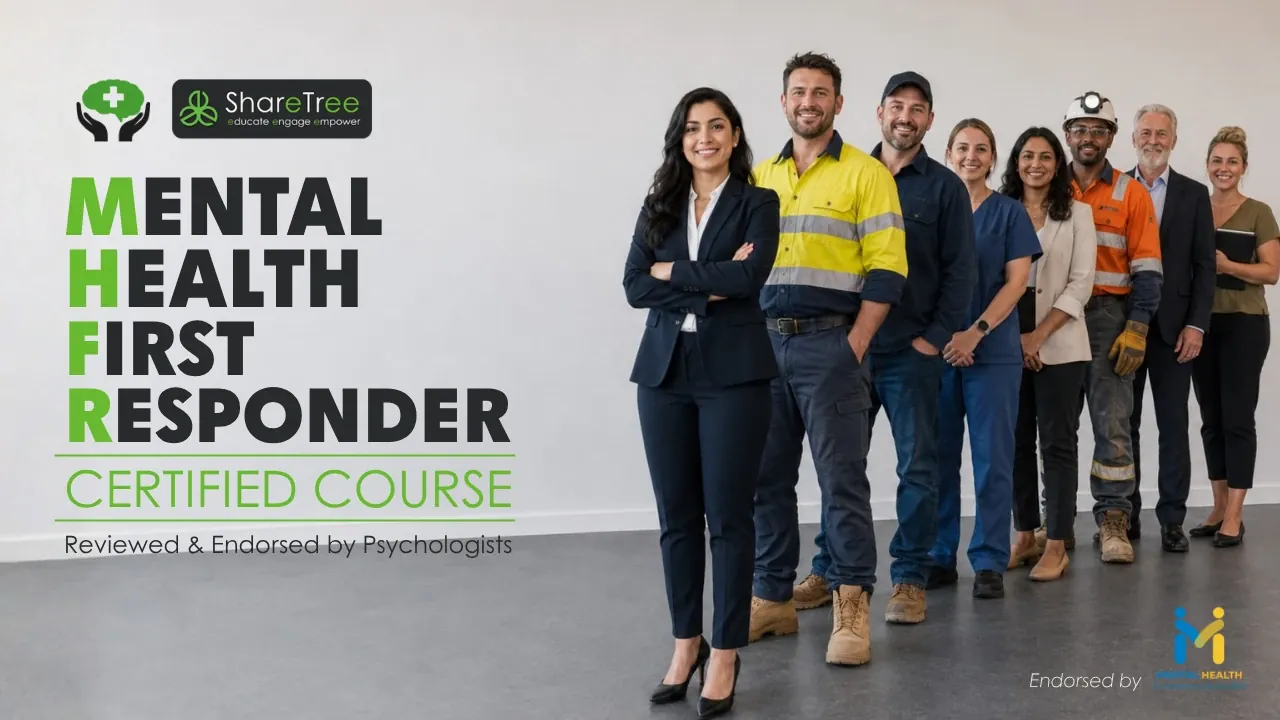
 Recommended by the Mental Health Foundation Australia
What to look for and how to respond: the signs of strain, the words that help, and the moments that need more than a chat.
The skills to support someone in distress. LIFT and ACT, practised in role-play until they hold under pressure.
The resources to act in your workplace: templates, escalation paths, and the confidence to carry the change through your culture.
Most distress is invisible until it isn't, and the people others turn to are trusted but untrained. Responders are not clinicians, mediators or investigators: they are trained peers who hold the right kind of conversation at the right time.
The quiet withdrawal
“You’ve seemed quieter this week. Is now an OK time to chat?”
A responder notices the early signal, fatigue, irritability, withdrawal, and opens a private, no-pressure conversation. They lead with care, not diagnosis.
The breaking point
“Thank you for telling me. Let’s work out what would help most.”
When someone discloses, the responder uses LIFT to listen with intention, inquire into feelings and needs, then find a practical way forward, without jumping to solutions.
The escalation
“I need to ask you something directly, because I care about your safety.”
Where there is risk of harm, the responder shifts to ACT: assess, collaborate on a plan, follow up. They know exactly when and how to escalate to clinical or emergency support.
The follow-up
“I said I’d check in today. How are you tracking?”
Responders close the loop. Timely follow-up is part of the framework; it is what turns one good conversation into sustained, trusted support, and prevents people falling through.
Boundaries, by design.
Responders are not clinicians, therapists, investigators or mediators. The role is non-clinical peer support with structured frameworks, confidentiality with clear limits, and defined escalation pathways. Those boundaries protect the worker, the responder and the organisation.
Both are built from clinical psychology, supportive practice and character-based coaching, designed for real workplaces, not textbooks. LIFT does the connecting. ACT does the reasoning. Underneath both is a simple sequence: get a person safe and steady first, build connection next, and only then work toward a way forward.
Listen, with attention and intention: empathic presence, no jumping in.
Inquire, with needs-based questions: “How are you feeling?” “What’s the hardest part?”
Find a way forward together to meet needs: supports, options, one small next step.
Thank them for their character strengths: acknowledge what you see in them, close safely.
Assess risk of harm: severity, frequency, escalation; ask directly when needed.
Collaborate on a safe immediate plan, involving the right people, with consent where possible.
Timely follow-up where appropriate; no one left unsupported.
Escalate to clinical or emergency services where there is high risk and low capacity to respond.
Trust is the programme's currency. People share when they believe they will be met with care, not judgement.
Care
genuine concern
Character
integrity over time
Congruence
consistent, authentic
Communication
clear, non-judgemental
Capability
knows the framework
The reframe the whole programme protects: from fixing to reflecting.
Responders carry compassion fatigue, and the failure mode is the fixer trap, wanting the solution more than the person does. The Mirror Technique, reflecting a person's own strengths back to them, is more effective, and it is what protects a responder's own capacity over time.
Every framework is rehearsed with in-person or AI role-play coaching until the skills stick: not just learned, but practised.
Practise a first-responder conversation with an AI roleplay partner, live, in your own words. A coach guides you through LIFT, then tells you what landed, what to try next time, and how your skills compare. It is the part of the programme people talk about afterwards.
About five to ten minutes. You'll need a microphone, or you can type.
Practise a real conversation with an AI role-play partner. A coach guides you through LIFT, then tells you what landed and what to try next time.
Test your skills, freeA microphone helps, or you can type.
Co-designed with qualified psychologists, mediators and character coaches. Every session combines content, structured practice and AI role-play.
Session 1
LIFT skills
Covers
Practice: Opening a conversation, holding silence, the empathy staircase, effective questions, closing safely.
Session 2
ACT skills
Covers
Practice: Four escalating scenarios including direct risk-of-harm inquiry and safe handover.
Session 3
Systems
Covers
Practice: Each participant leaves with a personal wellbeing plan and a workplace activation plan.
Included
An included online knowledge assessment certifies a Mental Health First Responder.
Optional
An optional skills assessment, shown by implementing a framework, certifies a Mental Health Response Expert, who can train others and be listed as a partner.
Two methods
Single-seat enrolment, anytime start.
Suits onboarding, busy leaders, practitioners and distributed staff.
Twelve participants included, up to 20 per group.
Ideal for workplace teams building a shared practice and culture.
Three modes
Every option leads to the same outcome: online enrolment, a certified Mental Health First Responder credential, recommended by the Mental Health Foundation Australia.
By the end of the programme, participants don't just know about mental health. They know what to say, when to escalate, and how to build the systems around it.
Open a check-in without freezing, hold silence, inquire without interrogating, close safely with thanks and follow-up.
Recognise escalation, ask direct safety questions, collaborate on a plan, escalate cleanly when risk requires it.
Know exactly what you do and don’t do: confidentiality with limits, non-clinical scope, clear manager and HR interfaces.
Risk assessments, referral pathways, escalation maps, wellbeing plans and psychosocial strategy templates, ready to deploy.
A trained responder network is a documentable control under ISO 45003 and the 2026 Code of Practice.
AI role-play for refresher practice, the Emotional Pulse app, community connection, and an annual recertification pathway.
75%
trained responders
20%
untrained staff
In our own self-reported research, 75% of trained responders rarely or never feel alone in distress, compared with 20% of untrained staff.Source: ShareTree user research, self-reported, February 2022 and June 2024 surveys.
“ShareTree are at the cutting edge of the sciences of education, psychology and whole-organisation change: innovative, dedicated, usually far ahead of the most recent science.”
Dr Derek Patton
Psychologist, formerly University of Melbourne
“A fantastic way to upskill and gain greater confidence in managing mental health in all settings, not just the workplace. I would highly recommend it.”
Philip Wolfe
Workplace wellbeing specialist
“I was sceptical when I first tried the AI, but was absolutely blown away after I tried it.”
Peter Mannfolk
They are not in competition. They answer different questions.
| Comparison point | Mental Health First Aid | Mental Health First Responder |
|---|---|---|
| Approach | Crisis intervention and professional referral. Builds awareness of conditions. | Prevention, promotion and early intervention. Builds skills for everyday support. |
| Method | ALGEE, a five-step plan for approaching someone in a mental health crisis | LIFT and ACT, practical skills that are easy to recall for supporting distress and risk |
| Skills built | Recognise conditions (depression, anxiety, psychosis) and refer to experts | Identify distress, hold a supportive conversation, guide to solutions |
| Duration | 12 hours, typically two days | Live: 12 hours (three sessions of four hours). Self-paced: 3+ hours of online content. Plus course access, AI role-play and community practice |
| Best for | Anyone wanting deeper awareness of clinical conditions and referral pathways | HR, managers, leaders, team members, teachers, parents. Early intervention. |
| Workplace impact | Raises awareness; relies on external professionals for action | Builds psychological safety, reduces psychosocial risk, shifts team culture |
| Resources | Training, online resources, handbook | Training, course access, AI role-play, the Emotional Pulse app, handbook, workplace templates |
Mental Health First Responder builds the daily skills. Mental Health First Aid broadens the clinical knowledge. Together they cover the full spectrum.
Mental Health First Aid trainingMental Health First Aid or First Responder: which does your team need?
12 to 20 participants
$3,500 for the group
$299 per additional person. Custom design on request.
$399 per person
for up to four people
$349 per person
for five to nine
$299 per person
for 10 to 49
$249 per person
for 50 or more
Volume agreements for 100 or more on request.
All prices AUD, excluding GST; travel additional for in-person delivery outside Melbourne.
Full pricingWhat happens next: four weeks to the first session
Week 1: Scoping and sign-off
Mode, team size, contact list.
Week 2: Platform set-up
Training plan provisioned, HR and L&D briefed.
Week 3: Internal launch
Team announcement, onboarding, responders nominated.
Week 4: First training session