Mental Health First Aid or First Responder: which does your team need?
Mental Health First Aid teaches people to recognise the signs and refer someone to professional help. First Responder training teaches them to act: to listen, support and escalate in the everyday moments when someone is struggling. Many people do both, in that order.
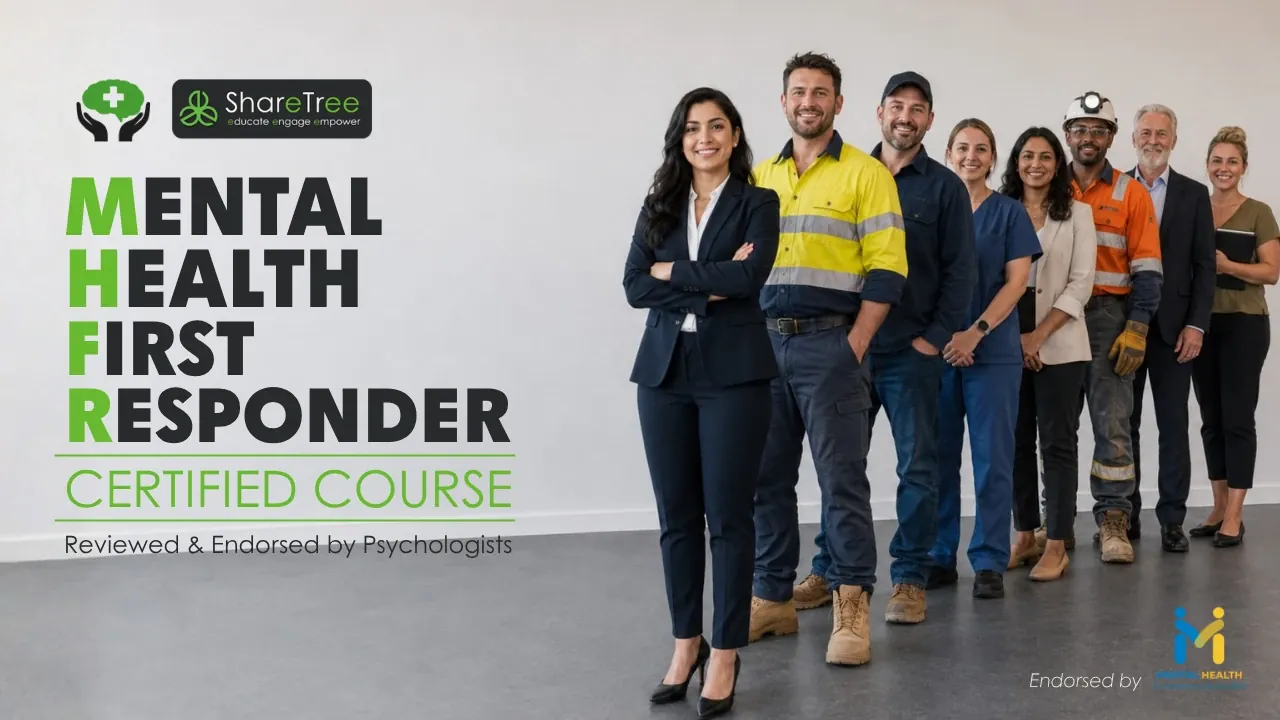
 Recommended by the Mental Health Foundation Australia
What Mental Health First Aid teaches
How to recognise conditions such as depression, anxiety and psychosis, and how to refer someone to professional help. Twelve hours, $440 per person.
What First Responder adds
The skills to act in the moment: LIFT for companioning distress, ACT for higher-risk situations, and AI role-play practice until the skills hold. From $249 per person.
Which your team needs
If you want people who understand mental health conditions, start with First Aid. If you want people who can hold the conversation and know when to escalate, start with First Responder.
Where Mental Health First Aid stops, and where this begins
They are not in competition. They answer different questions.
| Comparison point | Mental Health First Aid | Mental Health First Responder |
|---|---|---|
| Approach | Crisis intervention and professional referral. Builds awareness of conditions. | Prevention, promotion and early intervention. Builds skills for everyday support. |
| Method | ALGEE, a five-step plan for approaching someone in a mental health crisis | LIFT and ACT, practical skills that are easy to recall for supporting distress and risk |
| Skills built | Recognise conditions (depression, anxiety, psychosis) and refer to experts | Identify distress, hold a supportive conversation, guide to solutions |
| Duration | 12 hours, typically two days | Live: 12 hours (three sessions of four hours). Self-paced: 3+ hours of online content. Plus course access, AI role-play and community practice |
| Best for | Anyone wanting deeper awareness of clinical conditions and referral pathways | HR, managers, leaders, team members, teachers, parents. Early intervention. |
| Workplace impact | Raises awareness; relies on external professionals for action | Builds psychological safety, reduces psychosocial risk, shifts team culture |
| Resources | Training, online resources, handbook | Training, course access, AI role-play, the Emotional Pulse app, handbook, workplace templates |
Mental Health First Responder builds the daily skills. Mental Health First Aid broadens the clinical knowledge. Together they cover the full spectrum.
Mental Health First Aid trainingMore than a certificate. A practical capability.
By the end of the programme, participants don't just know about mental health. They know what to say, when to escalate, and how to build the systems around it.
- 01
Confidence in the conversation.
Open a check-in without freezing, hold silence, inquire without interrogating, close safely with thanks and follow-up.
- 02
Skill in higher-risk moments.
Recognise escalation, ask direct safety questions, collaborate on a plan, escalate cleanly when risk requires it.
- 03
Clarity on boundaries.
Know exactly what you do and don’t do: confidentiality with limits, non-clinical scope, clear manager and HR interfaces.
- 04
Templates ready for the workplace.
Risk assessments, referral pathways, escalation maps, wellbeing plans and psychosocial strategy templates, ready to deploy.
- 05
Compliance evidence on the record.
A trained responder network is a documentable control under ISO 45003 and the 2026 Code of Practice.
- 06
Ongoing practice and community.
AI role-play for refresher practice, the Emotional Pulse app, community connection, and an annual recertification pathway.
75%
trained responders
20%
untrained staff
In our own self-reported research, 75% of trained responders rarely or never feel alone in distress, compared with 20% of untrained staff.Source: ShareTree user research, self-reported, February 2022 and June 2024 surveys.
What practitioners say
“ShareTree are at the cutting edge of the sciences of education, psychology and whole-organisation change: innovative, dedicated, usually far ahead of the most recent science.”
Dr Derek Patton
Psychologist, formerly University of Melbourne
“A fantastic way to upskill and gain greater confidence in managing mental health in all settings, not just the workplace. I would highly recommend it.”
Philip Wolfe
Workplace wellbeing specialist
“I was sceptical when I first tried the AI, but was absolutely blown away after I tried it.”
Peter Mannfolk
Transparent pricing. Volume-friendly. No hidden costs.

12 to 20 participants
$3,500 for the group
$299 per additional person. Custom design on request.
- Format
- Three four-hour sessions
- Included
- 12 participants
- Additional
- $299 per person
- Maximum
- 20 participants
- Custom design
- On request
Individual enrolment
$399 per person
for up to four people
$349 per person
for five to nine
$299 per person
for 10 to 49
$249 per person
for 50 or more
Volume agreements for 100 or more on request.
Every enrolment includes
- Certified Mental Health First Responder training and credential
- Course access with AI role-play coaching for LIFT and ACT
- The responder handbook, cheat sheets and reference materials
- Wellbeing plan, risk assessment and referral pathway templates
- Workplace risk assessment and mental health strategy templates
- The Emotional Pulse app and ongoing graduate community access
All prices AUD, excluding GST; travel additional for in-person delivery outside Melbourne.
Full pricingTwo methods. Three modes. One certification.
Two methods
Individual
Single-seat enrolment, anytime start.
Suits onboarding, busy leaders, practitioners and distributed staff.
Group
Twelve participants included, up to 20 per group.
Ideal for workplace teams building a shared practice and culture.
Three modes
In person
- A certified facilitator on site
- Three four-hour workshops, twelve hours in total
- Highest engagement and practice
- At your nominated location; travel costs apply outside Melbourne
Live online
- A certified facilitator, live and remote
- The same content as in person
- Accessible across locations
- Three four-hour blocks
Self-paced
- 3+ hours of online content
- Full certification in the ShareTree Academy
- AI role-play for LIFT and ACT
- Anytime start, flexible pace
- Hybrid options available by adding live sessions
Every option leads to the same outcome: online enrolment, a certified Mental Health First Responder credential, recommended by the Mental Health Foundation Australia.
See how you'd do, right now
Practise a first-responder conversation with an AI roleplay partner, live, in your own words. A coach guides you through LIFT, then tells you what landed, what to try next time, and how your skills compare. It is the part of the programme people talk about afterwards.
- Real conversation, not multiple choice.
- Scenarios for strain, anger, sadness and flat affect.
- Feedback on what you said and what to do differently.
About five to ten minutes. You'll need a microphone, or you can type.
Could you support someone in distress right now?
Practise a real conversation with an AI role-play partner. A coach guides you through LIFT, then tells you what landed and what to try next time.
Test your skills, freeA microphone helps, or you can type.
Talk to us about training for your team
What happens next: four weeks to the first session
- 1
Week 1: Scoping and sign-off
Mode, team size, contact list.
- 2
Week 2: Platform set-up
Training plan provisioned, HR and L&D briefed.
- 3
Week 3: Internal launch
Team announcement, onboarding, responders nominated.
- 4
Week 4: First training session