Managing psychosocial risk: from policy intent to demonstrable due diligence.
Traditional systems track lagging indicators like disengagement and burnout. To meet the 2026 Australian Code of Practice, you need the earliest signal of risk, controls that reach everyone, and the record that shows they are running.
The 2026 regulatory shift: why business as usual is now a liability
By the time risks appear in surveys, exit interviews or WorkCover reports, the harm has occurred. Managing psychosocial hazards often feels reactive and administrative because you are managing outcomes instead of detecting movement.
The data is clear.

Rise in serious mental health condition claims in a single year, and 161.1% over the previous decade (Safe Work Australia, Key WHS Statistics 2025, 2023–24 data).

Median compensation for a serious psychological claim. More than four times the median across all serious claims (Safe Work Australia, 2023–24).

Weeks of median time lost for a serious psychological claim. The longest of any claim category (Safe Work Australia, 2023–24).

Of people ever use a traditional EAP. Support that waits to be asked reaches only a fraction of your at-risk workforce.
The Code requires active signals, not just annual snapshots.
The Code of Practice requires organisations to actively identify, assess and review psychosocial risks on an ongoing basis, not just document them annually.
Most systems detect risk once behaviour changes or claims are filed. The issue isn't your intent, it's your timing.
Here's what happens when early signals go unseen.
Emotional Strain
John, a high-performing Lead, becomes a full-time carer for his father overnight; he stays silent, but his internal capacity is instantly halved.
Emotional strain is now a leading indicator of risk, yet his KPIs remain "Green", creating a total blind spot for leadership.
The Withdrawal
Unable to sustain the dual burden, John quietly withdraws from team collaboration and stops contributing to the culture.
Quarterly surveys miss this weekly movement; the psychosocial hazard of role overload is now established but invisible.
Behavioural Change
A manager notices John is unkempt and exhausted but pushes for target achievement rather than exploring his capacity.
By ignoring visible strain, the business fails its primary duty of care to assess and control risks at the source.
Clinical Harm
John collapses into deep clinical depression; a psychologist mandates long-term leave.
The business is now liable for an aggravation-of-injury claim, the kind that now costs a median of $67,400 and 35.7 weeks away from work (Safe Work Australia, 2023–24).

The earliest leading indicator of psychosocial risk is an emotional shift.
Before a complaint is filed, pressure accumulates. Before performance drops, emotional strain builds.
Stress, overload and isolation move emotionally first.
A check-in with every person catches the shift. A daily pulse in between keeps watching. Trained responders act on it.
Identify, assess, control, review: controls that reach everyone.
Under Australian WHS law, you are expected to eliminate or reduce risk as far as is reasonably practicable.
Support that waits to be asked is an administrative control: it responds after the harm has occurred.
Reaching in gives you higher-order controls, and the evidence that they are running.
hazards
risks
risks
revise
Managing psychosocial hazards in Victoria

Compliance without surveillance.
Built on trust.
Early signals only work if employees trust the system.
For employees, it's early access to support.
For leaders, it's visibility without breaching trust.
Participation is voluntary, every cycle
Nobody is required to take part. A person can decline a call, skip a question or end the conversation, this cycle and the next, and nothing they say or do not say affects their work.
De-identified by construction, not by policy
What reaches your reporting carries no name, no contact details and no identifier that links back to a person. That separation is built into how the system is structured and enforced in the backend, rather than being a setting someone could switch off.
Minimum group sizes, always
Themes appear only across groups of at least five people. Smaller groups fold into larger ones, and views that could narrow a theme down to one person are switched off, so no small cluster can be singled out.
Patterns, not performance management
The output points at the work: which teams are carrying sustained demand, where support is thin, where change has landed badly. It is not an input to performance review, and using it that way would destroy the trust the data depends on.
Three solutions, one model
How reaching in meets the obligation
Three solutions, each a control in its own right. Start where you are.
The call that reaches everyone
Proactive check-ins
A scheduled, confidential check-in with every person, on a cadence you choose. Identification that does not depend on who speaks up, and a de-identified report each cycle.
Proactive check-insThe people who act
Mental Health Training
Your own leaders and responders learn to notice, support and escalate, and to carry the changes the report calls for. Capability inside the organisation, not in a vendor.
Mental Health TrainingThe leading indicator
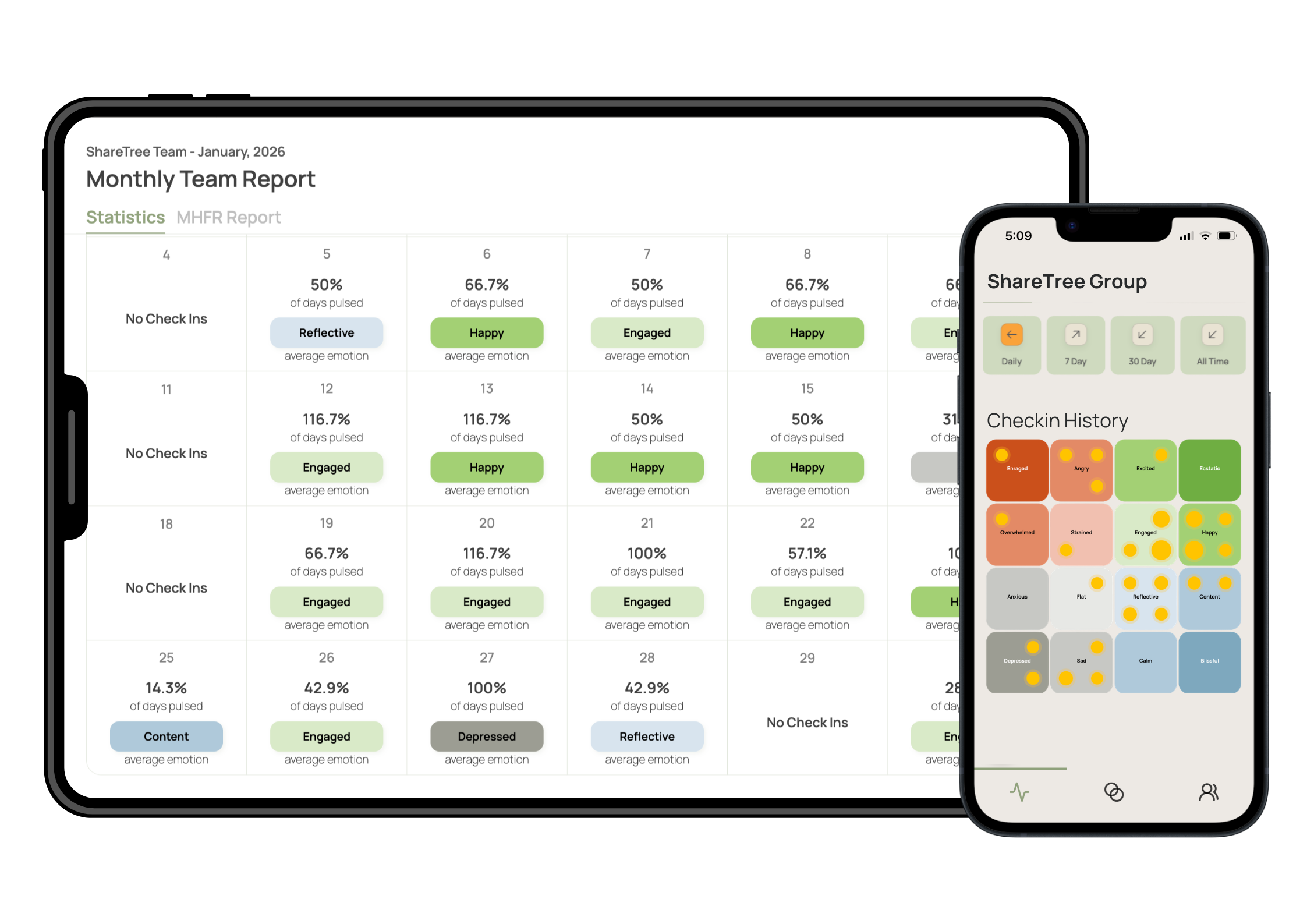
The Emotional Pulse App
A 30-second daily check-in, trusted pairs and de-identified team trends between the calls, so the review step has data every month, not once a year.
Emotional Pulse App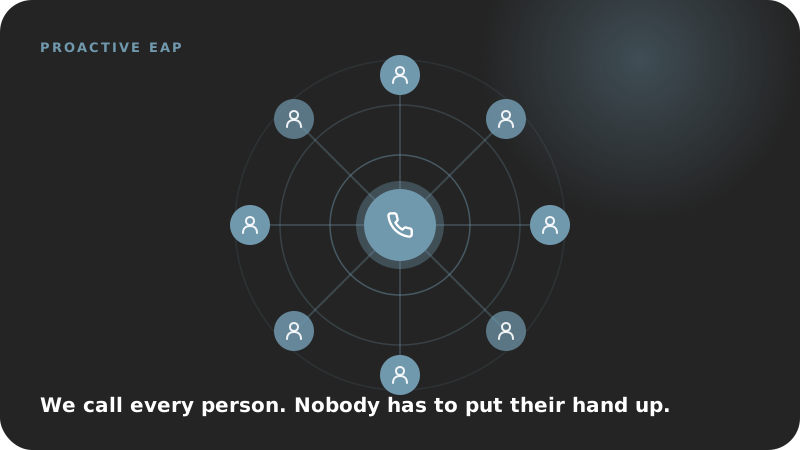

The call that reaches everyone
Proactive check-ins
Early intervention shortens distress and strengthens support.
From our own study across more than 50,000 check-ins in 118 countries.
increase in emotional awareness
feel more supported during challenge
less loneliness with trusted peers
Emotional strain precedes safety incidents
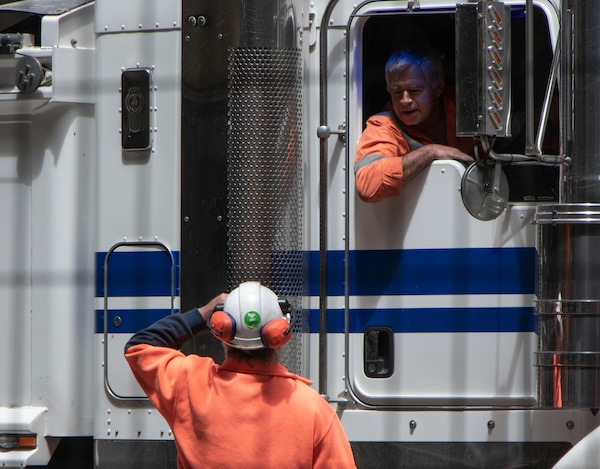
In safety-critical sectors like mining, healthcare, utilities and construction, emotional fatigue is a leading indicator of physical accidents.
Managing psychosocial risk isn't just a People and Culture task; it is core operational risk management.
Reaching in gives you the early signal, and the people trained to act on it, before fatigue becomes an incident.
Sample report
What you see after a check-in cycle
Click a factor, switch teams, or step through identify, assess, control and review. This is a sample for a fictional organisation with invented numbers.
Sample cycle, quarterly check-ins
Riverbend Freight Co.
Employees spoken to
81%
194 of 240
Unsuccessful contacts
11
to follow up
MHFR sessions booked
9
Avg. call duration
7:40
Work organisation
- Job security & precarious workNo signal this cycle
Social factors
- Organisational & workgroup cultureNo signal this cycle
- ⚠HarassmentNo signal this cycle
- ⚠Violence at workNo signal this cycle
Work environment
Work organisation · across all teams
Workload & work pace
- Mentions
- 28
- People who raised it
- 19
- Peak severity
- Chronic
- Trend vs prior
- ↑ 18%
By team
- Warehouse12
- Transport10
- Customer service4
- Finance and admin2
What people said, de-identified
- Shifts have been short-staffed most weeks since peak season started.
- Pick targets went up without a change to breaks or rosters.
- People are skipping breaks to keep up with the dock schedule.
Plain-language summaries, never anyone's own words.
All 20 factors are listed, including those where nothing surfaced. No signal means nothing was raised this cycle; it is not an assessment that the factor is safe or controlled.
- Team hiddenFewer than five people, rolled up into the totals
92 people · this cycle
Warehouse
Top factors raised
- 1Workload & work pace
- 2Job demands
- 3Support & supervision
Themes appear only for groups of five or more. Smaller teams fold into the totals so no one can be singled out.
Every person was offered a check-in this cycle, so hazards surface from the whole workforce, not only the people who speak up.
In this sample, Workload & work pace and Job demands surfaced most, concentrated in Warehouse and Transport. One escalation factor was raised and followed up.
Each theme carries a severity mix, the number of people who raised it and the trend against the last cycle.
Workload was raised by 19 people, mostly at strain and distress, up 18% on the prior cycle. That is the assessment input: how widespread, how serious, which way it is moving.
Your leaders and responders decide the controls, in consultation with the people affected. The report shows where to act first.
Example controls a business might record: rebalance peak rosters in Warehouse, add a mid-shift break, give Transport earlier notice of roster changes.
The next cycle is comparable with this one, so you can see whether exposure fell after you acted, not only whether actions were done.
Working hours & schedule is down 6% after last cycle's change to roster notice. Leadership is down 10%.
Questions about managing psychosocial risk

Replace policy intent with verifiable evidence.
In the event of an audit, boards aren't asked if they have a policy. They are asked if they can demonstrate active, ongoing risk management.
When emotional signals are visible, support is structured and trends are reviewed regularly, you move from documented intention to demonstrable control.
Other challenges we help with
Reducing Mental Health Claims
A claim is the last signal, not the first. Find what precedes one while it can still be fixed.
Read moreBurnout, Performance & Culture
Burnout, bullying and withdrawal show in performance long before they show in a survey.
Read moreBuilding Leadership Capability
From guessing who needs a conversation to knowing, and having it well.
Read more